
Meningitis Prevention Student Hub
Created for students, by students
(aka: your one-stop shop to keep your friends safe)
What is the Hub?
This hub serves as a central resource for peer health educators and students on all aspects of meningococcal meningitis. This type of meningitis is a severe and potentially deadly form of bacterial meningitis, and is also the most common among adolescents and young adults.
Our goal is to make it easier for you to educate your peers and advocate for meningococcal meningitis prevention strategies on college campuses.
Our job:
Help you educate your friends
Make campus safer
Give you easy tools to advocate for better meningitis prevention
Keep things simple, clear, and not boring
Everything here was built with real students, so it actually makes sense for real student life.

Key Messages on How to Talk About Meningococcal Meningitis
Quick, clear, and totally usable when you're talking to friends, roommates, RA groups, or campus orgs.
-
It’s an illness caused by the bacteria Neisseria meningitidis.
It is the #1 type of bacterial meningitis in teens and young adults (aka us).
There are five main types of bacteria that can cause disease: A, B, C, W, and Y.
If this bacterium gets into your body, it can cause:
Sepsis (a life-threatening bloodstream infection), or
Meningitis: Infection of the lining around your brain/spinal cord, or
Both. Basically: not something to play around with.
-
The scary part? It starts out looking like the flu. Or a hangover. Or “I’m just tired.”
But it escalates FAST.Look out for:
High fever
Stiff neck
Vomiting
Headache
Exhaustion that feels wrong
Sensitivity to light
A purplish rash
You can also be infected with no symptoms at all.
If anything feels suddenly severe or “off,” call a healthcare provider ASAP. This is truly a don’t-wait situation.
-
Short answer: normal college life. It spreads through:
Sharing drinks, vapes, utensils, lip gloss, etc.
Living in close quarters (dorms, Greek houses, apartments)
Coughing/sneezing
Kissing
Approximately 5–10% of people carry the bacteria without knowing it, and can still spread it.
-
It is more common than you think. Meningococcal meningitis affects all ages, and it can occur anywhere, but it is more commonly diagnosed among those aged 16-23 (teens and young adults).
Meningitis B remains the most common cause of cases and outbreaks on college campuses.
A recent study found that serogroup B is 5+ times more common in college students versus non-college students.
30+ college campuses have had cases of Meningitis B since 2008.
-
Meningitis can go from “I feel weird” to life-threatening in less than 48 hours.
1 in 10 people who get bacterial meningitis die.
1 in 5 survivors face long-term impacts like:
Brain damage
Hearing loss
Learning challenges
Loss of limbs
This is why awareness + prevention matters so much.
-
While it’s a devastating disease, the good news is that there are steps you can take to protect yourself.
Vaccines are the most effective way to protect yourself.
Because meningococcal meningitis is primarily caused by five types of meningococcal bacteria (A-B-C-W-Y), more than one type of meningitis vaccine is necessary to be fully immunized against the disease.
The Centers for Disease Control and Prevention (CDC) recommends:
MenACWY: First at 11–12 years old, booster at 16
MenB: Recommended for 16–23-year-olds, best at 16–18
MenABCWY (pentavalent): New option that covers everything (A, B, C, W, Y) in one shot but can only be used as an option when both the MenACWY and MenB vaccines are indicated (i.e., the 16-year-old visit).
In addition to vaccination, avoid sharing items with friends when possible.
You can learn more about vaccination here.
-
To be as protected as possible, you need to be vaccinated against all five types of meningococcal bacteria most likely to cause meningococcal meningitis: A, B, C, W, and Y.
While most have received the MenACWY vaccine, few students have received the MenB vaccine. That's because the MenB vaccine is relatively new, and not many colleges require it just yet.
Many colleges require the MenACWY vaccine for enrollment, but few require or even recommend the MenB vaccine.
If you haven’t received protection against all five serogroups, you are not fully immunized against meningococcal meningitis.
-
Your campus health center
A local pharmacy
Your family doctor, next time you’re home
Just make sure to ask specifically whether you are vaccinated against all five serotypes: A, B, C, W, and Y.
Educational Materials for Students
Just click to download. You can also order hard copies for your campus!


Additional Tools for Peer Health Educators
This material is ideal for RAs, student organization leaders, health ambassadors, peer educators, and student activists.
Educational Videos
Short PowerPoint Presentation
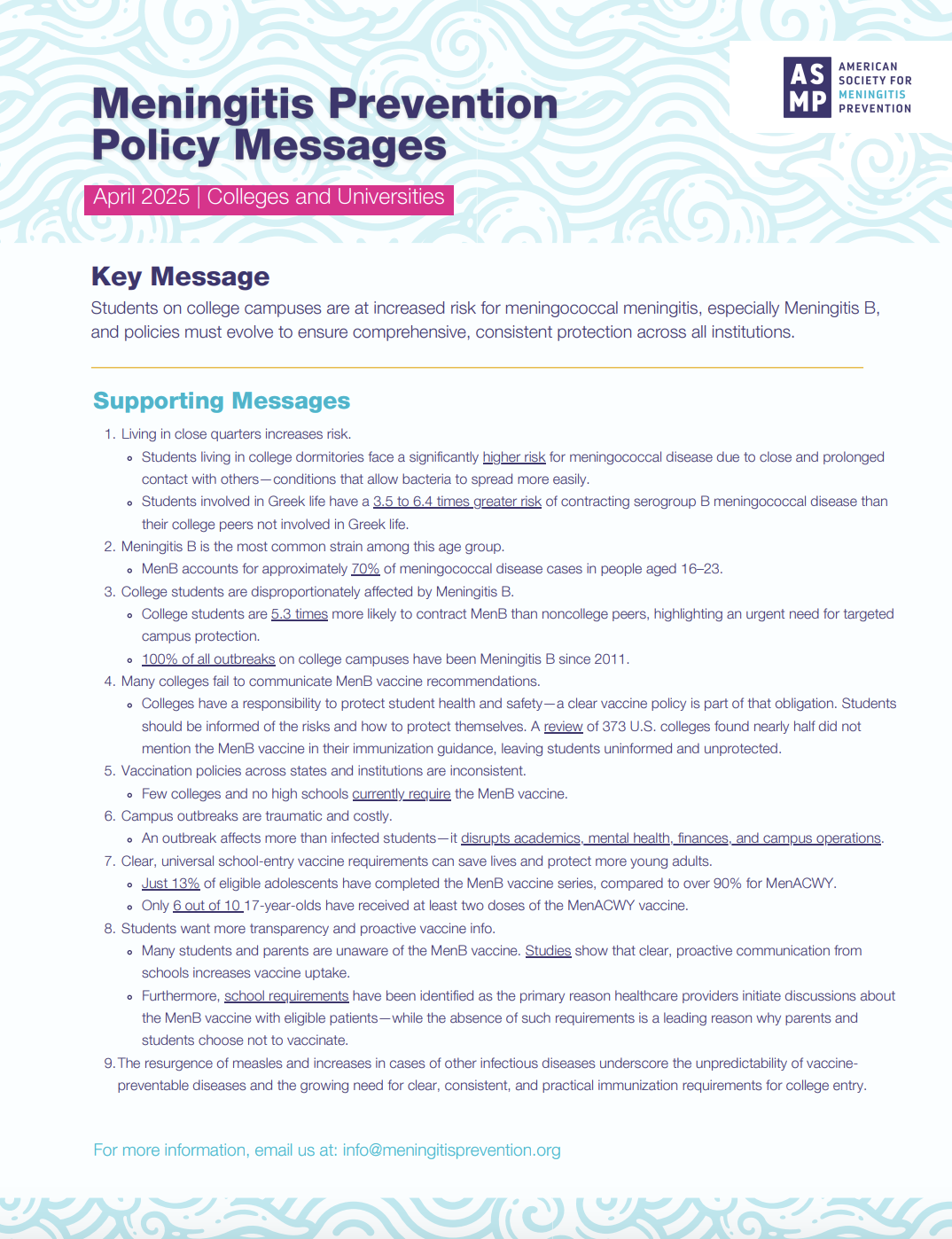
Key Messages for Administrators
Looking for static social media graphics?
Visit our dedicated webpage.
Tips + Inspiration
There are so many great ideas out there from students and peer health educators on building awareness around important health issues affecting young adults. Here are a few we loved. We hope these stories will help prompt ideas for improving awareness of meningococcal meningitis prevention on your campus.
Want to contribute your own favorite, or share how you’ve made a difference on campus? We’d love to highlight your work! Shoot us a quick note, and we’ll be in touch.
Why it Matters? Meningitis can kill in a matter of hours.
Or cause permanent disabilities like brain damage, hearing loss, learning disabilities, or limb amputations.
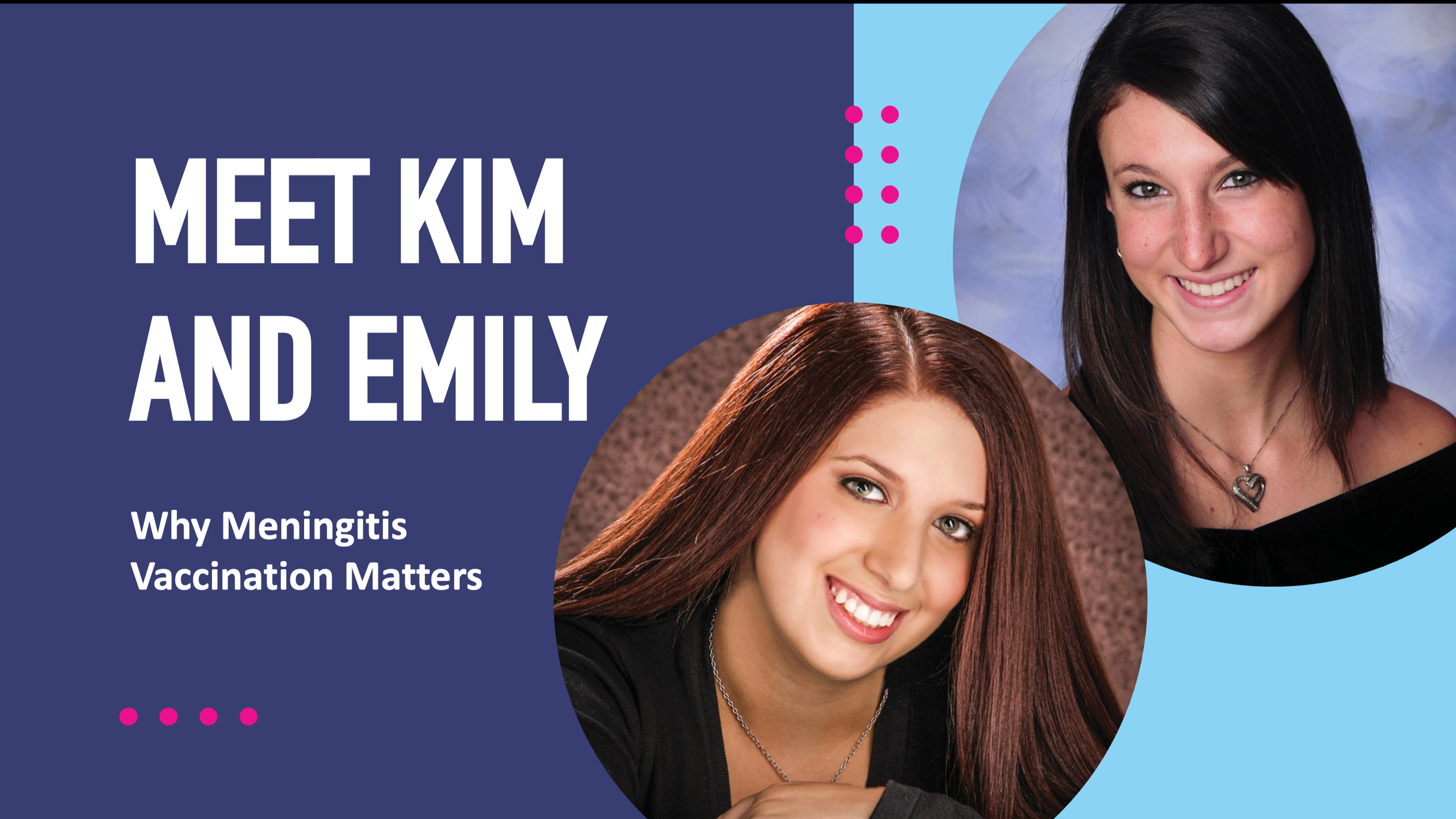
ASMP was founded in memory of two young women who lost their lives to meningococcal meningitis. Emily died from Meningitis B 36 hours after her first symptoms. Kimberly passed away from Meningitis B right before her high school graduation.

We would like to give special thanks to all of the students who helped develop this resource to ensure that college students are as protected as possible from meningitis.
Alex Singer
VaxTeen
Arin Parsa
Teens for Vaccines
Christopher Giang
University of Michigan
Elizabeth Chung
University of Virginia
Faith Farber
Kalamazoo College
Kaitlyn Maurais
Skidmore University
Kelly Danielpour
Stanford University, VaxTeen
Melanie Arnold
Icahn School of Medicine at Mount Sinai
Mira Bagous
University of Virginia
Nataschia Wibben
University of Oregon
Nick Lucido
San Diego State University
Sidney Simpson
Clemson University
Thérèse McCusker
Rutgers University
Yara Hussein
University of Oregon